

Construction work has always been associated with high levels of physical exertion and risk. Despite advances in technology and automation, a significant portion of tasks are still performed manually by workers. In such conditions, the issues of safety, monitoring employee well-being, and process transparency become crucial. That is why interest in wearable devices in the construction industry is growing year after year. Technologies that seemed experimental not so long ago are gradually becoming standard.
Why wearable devices are needed on construction sites
A construction site is a dynamic space where people, materials and equipment are constantly on the move. In such conditions, it is difficult to maintain full awareness of the status of each employee and the progress of work. Wearable devices help to compensate for this information gap. They make it possible to:
- track the location of workers,
- record physical activity levels,
- warn of fatigue,
- and reduce the likelihood of errors and accidents.
The purpose of such solutions is not only safety. They allow you to manage processes and communication. Whereas foremen used to rely on visual observations and experience, today there are tools that provide objective data and make processes more transparent.
Main directions of wearable technology development
Modern wearable devices in the construction environment can be divided into several categories. Any device must be compatible with the conditions of the construction site. This means resistance to dust, moisture, and impact, as well as comfort during prolonged wear. If the technology cannot withstand real-world conditions, it simply will not catch on.
1. Clothing and equipment with built-in sensors.
These can be helmets, vests, gloves and shoes. They monitor a person’s condition: heart rate, body temperature, position in space.
2. Exoskeletons.
Mechanical structures that help relieve the muscles of the back and arms. They reduce the load when lifting heavy materials.
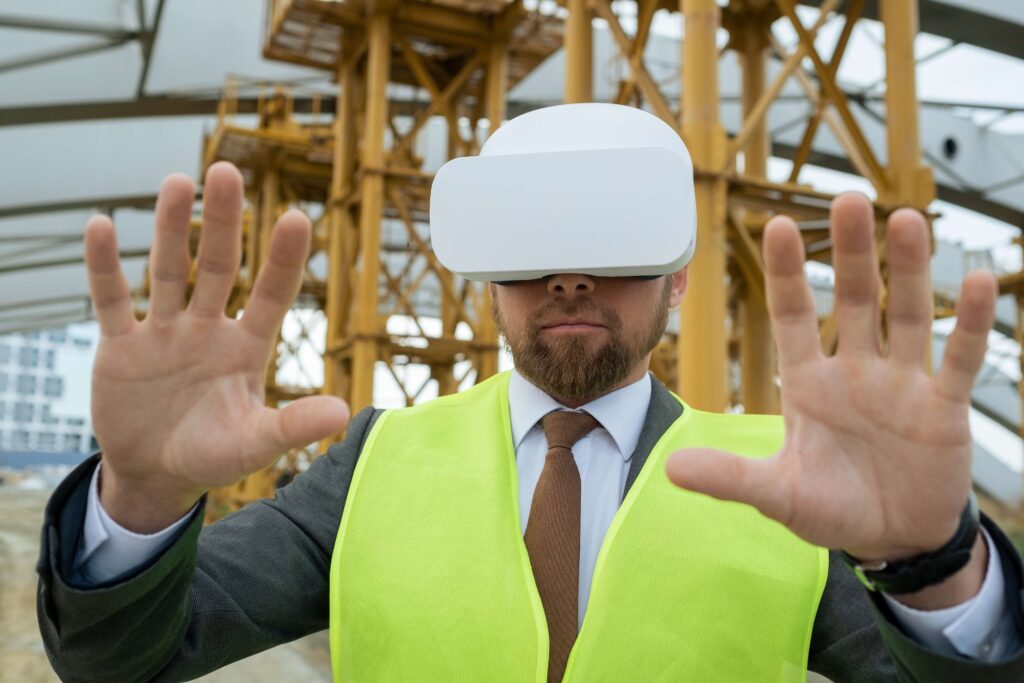
3. Augmented reality glasses.
Used for visualising drawings, training, and remote consulting.
4. Personal trackers and beacons.
These help to determine the location of workers, monitor their movements and respond promptly in the event of a fall.
After implementing these solutions, managers gained access to information that was previously unavailable or only available in the form of guesswork.
Exoskeletons on construction sites
One of the most notable categories of wearable devices is exoskeletons. They are designed to support muscles and joints when performing heavy tasks. An exoskeleton distributes the load so that a person has to exert less effort. This is especially important when repeatedly lifting heavy materials, working at uncomfortable heights, or maintaining the same posture for long periods of time.
Exoskeletons can be passive (without electronics, simply redistributing the load) or active (with drives and sensors). Passive models are lighter and more commonly used. They do not interfere with movement and do not require power. Active models allow for more complex tasks, but require time to set up.
The use of exoskeletons has helped reduce the number of back and shoulder injuries among workers. Where workers used to tire by the middle of their shift, they can now perform tasks for longer without compromising quality.
Smart Boots: an example of application
Previously, smart protective boots developed by companies specialising in industrial equipment were used on construction sites. Such models were used in projects where it was necessary to monitor worker fatigue, control falls and improve coordination.
The sole and body of the boot contained sensors that recorded the position of the foot, pressure and walking speed. If the system detected signs of severe fatigue or risky movement, a notification was sent to the shift supervisor. In some cases, the boots also helped to determine the location of the employee and triggered emergency signals in the event of a fall. This helped to prevent incidents in the category of the so-called ‘fatal four’ – the most dangerous situations that often led to injuries and fatalities.
Smart helmets, vests and gloves
Wearable equipment with sensors was one of the first areas of technology implementation on construction sites. Such solutions look familiar, so they do not cause resistance among workers.
For example, smart helmets can record body temperature, recognise sudden movements and report falls. Vests with breathing sensors track recovery speed after exertion. Gloves with sensors can determine grip strength and movement dynamics. All this helps to improve safety and take a fresh look at how work is organised.
How wearable devices reduce risks

Most accidents on construction sites occur due to overload, inattention, and lack of awareness. Wearable devices allow you to track the first signs of dangerous situations before they escalate into a problem.
The system can detect changes in movement amplitude, which indicates fatigue. Or determine that an employee is in an area where hazardous work is being carried out. What used to depend solely on personal experience and observation is now controlled at the data level. The main advantages of implementation are:
- injury prevention,
- reduced response time in emergency situations,
- increased employee awareness,
- reduced employer costs for insurance payments.
These changes are gradual, but both employees and companies benefit from them.
Prospects and conclusions
Wearable devices are no longer just a technological fad. They are becoming a tool for interaction between people and their working environment. Construction processes are complex, and the human factor will always be present. However, the level of risk can be significantly reduced by providing additional control and support mechanisms.
Where technology is used wisely, safety and quality of work improve. Workers get less tired, tasks are completed faster, and information about project progress becomes more accurate.